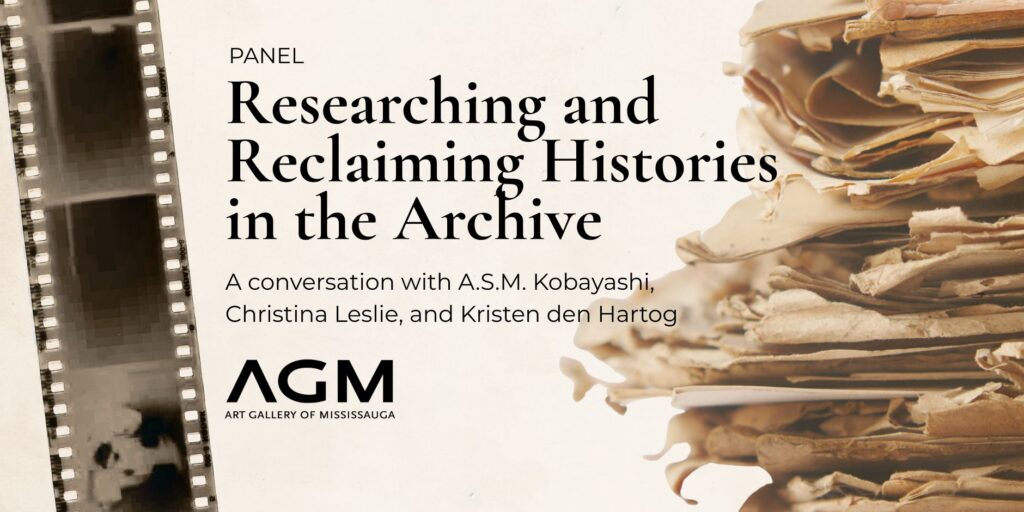
Moderated by TD Curatorial Fellow, Steffi Ng, Researching and Reclaiming Histories in the Archive brings together three distinct voices operating at the intersection of archival research, historical trauma, and creative production.
Kristen Den Hartog’s non-fiction works The Occupied Garden and The Cowkeeper’s Wish examine her family’s histories in wartime Holland and England. In her recent book The Roosting Box, exploring Toronto’s Christie Street Hospital after World War I, den Hartog weaves together medical files, scrapbook photographs, and war poetry to reconstruct the experiences of injured soldiers. A.S.M. Kobayashi transforms historical documents into performance and installation. In addition to her past work Say Something Bunny!—which resurrected a 1950s wire recording, Kobayashi details her project and exhibition Electric Neon Clock focused on her father’s family history. Utilizing digitized government custodial files from the Landscapes of Injustice project, she examines the forced displacement and dispossession of Japanese Canadians during World War II, staging her performance in the format of a live auction. Artist Christina Leslie discusses her critical engagement with Caribbean history and the legacies of colonialism. In Sugar Coated, Leslie invented an ingenious photographic process using sugar itself to hold historical images, grappling with the grueling history of enslavement. Her current exhibition, The Album, currently on view at the MacLaren Art Centre, is a personal series exploring her parents’ relationship, respective childhoods, and the disparities in documented family histories.
What follows is an edited transcript of the panel conversation which took place at the Art Gallery of Mississauga on September 29, 2026.
Steffi Ng: I find it really fascinating when we’re thinking about archives, we usually think about government records or official albums, but from your presentation, we know that you pull a lot of different resources from treasure boxes, oral histories, and visual presentations as well.
So I’m just thinking, do you mind walking us through your process of how you pull all these different aspects together, and where do you sort of first identify the things that you want to explore further?
Kristen Den Hartog: I think the first thing that comes to mind for me is my most recent book, The Roosting Box where I decided that all the chapters would be named after parts of the body. That happened because when I first started researching the Christie Street Hospital and realizing all the different kinds of people and all the different kinds of wounds that had been treated there, I just started matching up the names of the people who had been in the hospital with the service records at Library and Archives Canada. There was so much information.
So, just for ease of organizing my research, I started plugging them in: “Okay, that’s a leg guy,” “That’s an arm guy,” “This one had spinal tuberculosis,” those kinds of things. I had all these different files that were parts of the body, essentially.
Then I realized, as my research went on, that that might actually be a really interesting way to structure the book. At the beginning of each chapter, I also situated the hospital and tried to move the hospital’s story along chronologically, and then sometimes the characters appear in other character’s chapters as well. That’s the first thing that comes to mind as far as classifying, organizing, or figuring out what to use.
Steffi Ng: How long does it take you to sort out everything?
Kristen Den Hartog: You know, it probably took five years to work on the book, but that’s different things going on all the time. Sometimes it’s research-heavy, sometimes you’re in a great writing space where you can just write and write, and then comes something that you don’t have the information for. It’s a lot of moving back and forth.
A.S.M. Kobayashi: I think there’s like so much speculation in an encounter with an archive. In my work in Electric Neon Clock project and previous projects like Say Something Bunny!, I’ve been using the graveyard as an archive. How graves have information carved in stone, how permanent, confident, and definitive it is.
My grandfather’s gravestone says his birthday is June 15th, which is when celebrated it. But, then I found this letter to the government that he wrote asking, “Can you update my birthday in this government record? I was actually born five days earlier, but we just registered my birthday late, and as a result it was logged as the day registered instead of when I was born.”
I thought, all of the family members know his birthday to be the government-documented birthday, not his actual birthday. Of course, this was a generation where a lot of people didn’t know their actual birthdate, but my grandfather did and tried to correct it.
It broke some of my trust in a grave. I think these panelist are really good at filling in the gaps and working with those contradictions.
Steffi Ng: Did your great-grandfather change his birthday eventually?
A.S.M. Kobayashi: No! His grave states his government registered birthday, not his real birthday. In my project that’s looking at government records, how that bureaucratic birthdate record became a more permanent record, even when he tried to say, “No, it’s not right,” it still stuck.
Kristen Den Hartog: Makes you think, “What else is wrong?”
Christina Leslie: My project Sugar Coated, I feel like I’ve done the most research for.
Originally, I was reading a lot of texts, Orlando Patterson’s Slavery and Social Death, The Confounding Island, I was reading a lot of broad research. But then I wanted to know further about the people, because I feel like this history, we think of it as a mass of people, but I think it’s more important to focus more on one, because then we can personalize it. History becomes something for us to resonate with.
For me, I would look at the research, and if there was a name that had a glimpse within the larger narrative, that’s where I would focus in and start thinking about making imagery around that individual, or that area, or that particular brand. That’s how I would focus really large and then get really small.
Steffi Ng: I know Sugar Coated the series is still sort of ongoing, how long does it take you have that focus of the research?
Christina Leslie: It’s probably going to be a body of work where I will keep adding on to it over and over again because there’s so much that isn’t told and there’s so many gaps.
As I’m researching, I will keep adding to it. I’ve sometimes had to step away from it because it is really jarring to read such brutality. There are so many things I have seen that I was like, “Oh, this is horrible.” So I’ve taken on-ramps and off-ramps, but I think I’m just going to keep making work around it because it is important.
Again, I feel like this history gets relegated to footnotes, so I feel this custodial responsibility to share it with the world.
Steffi Ng: A lot of the histories that all three of you are handling are really private in terms of family history, but at the same time very vulnerable and painful as well. How do you approach these difficult histories with care, while also living with the responsibility? What sense of ethics do you bring to your artistic practice?
Kristen Den Hartog: A couple of things come to mind with that. We were very lucky when we were writing The Occupied Garden, which is the more recently set story from World War II and is about our Dutch family. My dad and his siblings were all alive when we were doing that research, my grandparents were long gone, as I mentioned, but they were all really okay with us telling that story. They were okay with any question that we wanted to ask, and we sometimes had to go back and ask it again and again to get more down to the heart of things, because some of them were more forthcoming than others.
But there was this weird feeling, because our grandparents were no longer alive. Our Oma was a very strict, very religious, very not-warm mother. We wanted to present her the way she really was.
We kept having this feeling like, “Are people going to think Oma was really an awful person?” We kept thinking, “Do we need to soften this a little bit?” But then we were like, “Well no, that’s what they said she did.” We ended up just saying, “No, I think we need to write it the way that it really was.” This is our interpretation of the story.
After the book came out, we got so much feedback about how moving that character was, because you can imagine trying to raise children in a situation like that: your country’s been taken over, there are soldiers in the streets, awful stuff happening all the time, your kids lose their limbs because a bomb landed in their backyard… It’s a lot for people to go through.
I think I kind of went away from what your actual question was asking me, but that’s what came up for me: how we decided to put her forward as she was, and people received her with love, curiosity, interest, and empathy, trying to imagine what it was like for a mother at that time.
A.S.M. Kobayashi: My research kept going back to what the custodial file tells me about my family members. I learned stories that felt more private and more vulnerable from people, but since they weren’t totally connected to the file, a lot just couldn’t make it into the project. I kept asking myself, “What does this say about my family, and what can I learn from the family from this document?” But then also, the file allowed me to have a different conversation because I had more information about their origins.
My previous work is more comedic, and this is heavy work. We are concluding the exhibition with a series of performances, and in some ways, that’s an attempt to bring levity to it. I realized that I’m not going to find that much humor and joy in this internment narrative, but I have humor and joy, and so I can try and bring that through making it live, bringing people into the auction. The live performance is a live auction format including tension that brings up and having fun playing with that. It’s also a very joyful thing to research and have discoveries. The research process itself is quite playful and joyful, even if it’s about something that’s quite heavy.
Christina Leslie: I think for me, I do approach that particular project with some level of care, especially because I don’t always want to recreate Black trauma. That’s kind of this term that our community uses when it comes to large systems of oppression in this history.
So how do I balance educating people by introducing an image that spoke about this history without also repeating the trauma? I find that I’m always kind of walking the line. There are some images that I have made, but then I think about it and I’m like, “Am I just repeating what we see in February all the time?”
I say this because I don’t also want our history to always be around this notion of slavery, but because this work is talking about the archive and reconstructing things, I do feel this responsibility to do it with a lot of care and just a lot of, you know…
And I also have asked other people before I include the image: “How are you feeling? How are you sitting with this? Is it too much?” I always listen to my peers’ responses too, because I think that’s important as well.
Steffi Ng: Speaking of playfulness, when you’re approaching all these materials and archives, and speaking with people, are there any fun surprises that you’ve encountered while doing your project?
Kristen Den Hartog: Yes, but again the first thing that comes to mind maybe turns the question a little bit.
In The Roosting Box, the one about the World War I soldiers at the hospital in Toronto, I decided that I wanted to do something with the story that was kind of unusual. I kept coming across a lot of poetry that was written in the First World War, and although these poets weren’t patients at the Christie Street Hospital, I was reading through their poetry to try to get an idea of what other people would have been reading at the time. I kept coming across all these lines that were really beautiful and I wanted to use them in some way.
So I just started a document and I would put those different little fragments into this document, not knowing what I was going to do with them afterwards. What I decided to do was weave them into my own writing and have them look just slightly different on the page—so just a little bit paler text, and slightly italicized—so that it would stand out to the reader like, “Oh, there’s something different about that piece.”
Then at the end of the book, you see them listed and you understand that these are fragments of writing by people who died during the war. So, it’s not terribly playful, but it is playful in what I do as a writer! For me, it felt like a lovely way of blending their work with mine.
A.S.M. Kobayashi: I’m working with the composer Bradley Kurushima on the score and I was really interested in ‘on-hold music’. When you call a company and you’re put on hold, what you’re listening to, the quality of that…
I needed to find reference music. I would call these government organizations and ask, “Hi, I’m an artist. I don’t need to reach anyone, could you just put me on hold?”
They were a bit confused but would always do it. So I recorded the music, and also the conversation leading up to it. It was just very fun to have these interactions.
Christina Leslie: The Album brought a lot of joy, and it was fun to hear my parents speak about the entirety of their relationship. Again, because there was such a disparity in the documentation of my father’s childhood, all I have is to rely on these stories.
So you’re imagining what a particular event looked like, and then my mom, her memories are a bit more vivid because she has a photograph to match the story. I think that was fun.
Even Sugar Coated, the process to make it, although it’s taxing, the way I arrived at it, which was a very happy mistake, I leaned into it. So even though the work is a bit harder to sit with, the process in itself I enjoy making.
Steffi Ng: Talking about the opposite of joy, thinking about the challenges, I think all of you have touched upon when you’re approaching an archive or working with all these materials, the access or potential lack of access to it. How do you navigate that process when you say there are gaps within those archives?
Kristen Den Hartog: For me, the gaps are some of my favorite things.
It sounds kind of funny to say, because I have written fiction as well, so I know what it’s like to have the freedom of being able to make a story go wherever you want it to go. But once I started doing non-fiction and fell in love with using archival material, it felt really important to tell the story the way it actually was.
That’s very difficult to do because there’s so much research and work involved, and you don’t know what little fact might be out there that you’ve missed. So that’s very hard.
But one thing that I really love is when there is something that you can’t possibly know, you know you’re never going to have the answer to that for your story. Then your story gets to bloom in this different way, because what I do personally is I ask that question: “What could have happened to so-and-so?” or “Why did she never come back?” I ask that question in the story, and then I get to explore.
Maybe there’s an example of someone else who went through something similar and this happened. It just allows some room for imagination and the empty spaces that exist when we look back in history. We can’t know everything, and to me that’s one of the really beautiful things about it.
A.S.M. Kobayashi: I’m an amateur and a bit of a bad archival researcher in some ways. I think I’m very willing to go to places, but I fail a lot.
I went to the National Archives during the holidays, on New Year’s Eve to be exact and of course couldn’t get access to the materials I wanted to access.
I also recognize kismet within the process, thinking, “I failed on this end, what am I going to do? I’m going to have a lovely conversation with the guy at the coat check!” Where is that going to take me? Then it might lead to something unexpected.
For my previous project Say Something Bunny!, I went to an archive to find a really old film from the 1920s about one of the characters who was a child actress. I watched four out of five of the reels, and the one that she was on was the missing reel.
But while at the Library of Congress, I decided to wander around, going to their sound division. I was talking to the archivist about my project and he was like, “Oh, this guy who lived in New York would record all these musicals on a tape recorder and donated his entire collection.” I was researching a characters who wrote ‘nudie musicals’ in the 1970s, and they had a recording of his musical! I thought, “Oh my gosh!”
So one failure leads to something that you didn’t even know was there, and kind of just trusting that in these archival visits.
Christina Leslie: The gap is what makes me want to create access. That’s what compels me. In most of my work, there’s always a gap that I’m trying to provide some kind of presence to.
Steffi Ng: Are there any parts that you find really challenging especially?
Christina Leslie: Yes. When I was creating Sugar Coated, another artist, Bushra Junaid, was really interested in what I was doing, so we sat down and talked. She provided me with a plethora of information around the boats, and that Canada also has a connection to this history that we kind of think that we don’t, but we do.
Even things like that, just being able to talk to other artists who can fill in some of these missing elements because they themselves are curious about it in their practice, that was another interesting thing for me.
A.S.M. Kobayashi: Kristen, I appreciate in your presentation that you brought up the unreliable narrator, because I also feel like I am one! I often say, “I’m an artist doing this, I have a different responsibility to this history and I’m doing the best I can, but it’s flawed.” Come with me on that journey of trying to get to the centre of it.
I want to share what I know, but a person who’s a fisherman is going to have an understanding of my great-grandfather’s life as a fisherman that I just do not understand.
There are so many gaps in my story. It’s just acknowledging and accepting the flaws in some ways and thinking, “Keep going with me in that,” and that the audience is there with me trying to fill it in.
Kristen Den Hartog: Just to add to that, I touched on how we would ask questions of our family members, our dad and his siblings, about an event that happened in their childhood, and they would tell entirely different stories. My sister and I would look at each other like, “What are we going to do about that?”
We would just put both in! “He said this, and he said that.” It actually became a really lovely part of the book, because there is a haziness to our memories.
Shannon Anderson, AGM Senior Curator: What’s really interesting about each of you is that you’re not archivists, but you engage in archival activities to create.
That’s really fascinating in each of your works because those gaps leave room. They come through in the work you produce, too, and it’s not an attempt to tell everything truthfully or completely. That leaves room for us as audience members, viewers, or readers to be able to use our imaginations, too.
The way you work carries through in the way the work is seen and realized, that the archive is authentic, but it’s not always truthful, and there’s so much complexity to it. You each do that for us in very different ways.
Audience Member: Kristen, when you write, do you write using your imagination, or what you hear from family interviews? or…
Kristen Den Hartog: Do you mean do I embellish the story or add things where there are gaps?
No, we decided not to do that when we first wrote The Occupied Garden together, the one about our Dutch family. We talked about that and decided that we didn’t feel comfortable imagining what our grandparents felt unless we had a way of knowing from something that we had been told, then we could give them that feeling or thought.
We allowed ourselves that kind of room, because we knew those people, and we had access to their children who knew them even better than we did.
And then with The Cowkeeper’s Wish, which was the next book which went back to an earlier time period, we wrote even from a further distance. We would fill in gaps by talking about things that had happened to other people that were similar. So it was a very kind of a journalistic approach, but the narrative is more like a novel when you read it. And the same with The Roosting Box, I also wanted to stick to what actually happened and build the story in other ways to give it that intimacy and ease of reading. So they don’t read like dry history books, they read like stories, but they’re true stories.
Audience Member: I’m a retired archivist. My question is about the language that you choose to use. So when you’re researching in the archives, or looking at something, what’s in the photograph, the material is expressed and described in a particular way from the perspective of people of that time.
As an example, Alison, you also talked about incarceration, internment, and evacuation.
Nowadays when we think of evacuation, well that’s kind of a good thing, you know? From a wildfire. But when you do the research on the government files on individual case files related to what was done to Japanese Canadians, and you go back even further even before Pearl Harbor, perhaps you go further back to the experience of the community… How do you work with the words? My question’s for all, how do you work with the words that you see in the archives relative to your feelings and what you’re trying to express as an artist?
Christina Leslie: It’s interesting you say that because I think now, particularly in my case, you know, that we had conversations about DEI, whereas now certain books are being banned by a certain administration. Some of this stuff is not available to me that was available a couple of years ago, and had I not printed those stuff, those documents, I would not be able to access it.
And even looking at certain words within that document to try to see if I could find something similar, I couldn’t because certain words are not allowed to be used, like “slavery.” And you’re thinking, “But this happened!” It’s almost like if we erase these words, the history never happened.
And I’m very particular in the words I use to describe it: I never say “slave,” I say “enslaved.” I never say “master,” I say “enslaver.” I say things like “abducted,” because they were abducted. So I’m very particular about the words I use to talk about this, because I also think this history uses language to lessen the severity that’s attached to it.
Kristen Den Hartog: I think for me, I find it more interesting as a writer to position myself now and let the reader know that I’m telling the story. So I get to talk about things that happened, different attitudes in the First World War, and different people who participated and the attitudes towards different races and women and all those kinds of things.
I can insert things that position me now, talking about what it was like then and what people’s attitudes were. I don’t feel the need to be telling the story from their time period. So that just gives me more freedom in addressing things that wouldn’t be, they’re not appropriate ways to talk about other people, and they’re not giving the full story if we stay in that old time period.
Audience Member: You see that as an artistic responsibility?
Kristen Den Hartog: Yeah. Well, it’s more interesting to me, you know? That’s a whole part of what I’m curious about.
So for instance now, I’m working on a new non-fiction book now that is set in Toronto in the 19th century, and it follows the man who owned the land that became High Park. He was a British guy that came over and plopped himself on that land. Who had that land before? Who was there before? And who were the servants and the working-class people around him that aren’t in the records as obviously?
So if I get to position myself now, I can explore all that stuff in a much more interesting way.
A.S.M. Kobayashi: Electric Neon Clock is really trying to engage with multiple perspectives, including the custodian’s perspective. This work includes both terminology of relocation and incarceration hoping to show the juxtaposition of that language.
I’m self-consciousness, too, because my family was sent to the prairies on a work farm. I had previously wondered, “Were they interned? Can I say that?” It wasn’t an internment camp. I’m always learning more and it get more complex. I’ve received corrections from legal historians around the term ‘enemy alien’ vs. ‘canadian citizens’, that Japanese Canadians didn’t actually have citizenship until after the war. There are so many layers to all of it!
Also so many people in this generation changed their name. My great-great-uncle Victor was Kazumi before the war, but for the purpose of this project, I chose to use how he’s being referred to in the custodial file. It’s a complicated thing to navigate because there’s so many words to describe one thing, names to call one person.
Audience Member: Was there a specific moment or an encounter or a feeling that really motivated you and energized you toward pursuing these projects and making them happen and become something? Where there’s something that just “I have to do this, and I feel this, a passion for this idea that I want to do.” Just curious if there was such a thing for each of you.
Kristen Den Hartog: For The Roosting Box, the reason I started doing that research in the first place was just because it was kind of a hangover from the previous book where we’d done so much research about the First World War in England. And I thought, “Oh, what was it like here?” In fact, I kept saying to myself, “Don’t go down that road,” but I was just curious. I wanted to see pictures, I wanted to see all kinds of stuff.
And then I came across this picture of the building that had been a cash register factory. And then I came across a booklet that listed pages and pages of patients’ names. I knew that all the service records for Canadian soldiers were digitized. And I thought, “I could take those names and find every record.”
And then I just thought, that’s an amazing piece of information. And the booklet was full of all these candid pictures of the soldiers, and you know, with no legs or missing arm, and all just kind of arms around each other, and the kinds of photographs, they weren’t formal photographs, it was very much like a scrapbook. And it had names under the pictures, too, and I just thought, “This is just such a wonderful amount of information, and if I can marry that with the service records, which are sometimes 90 pages long and give a ton of information…” I just had to do it. So that was probably the moment for me.
A.S.M. Kobayashi: I think it was when I was at a residency and I figured out that the auction would be a format to explore this story. Before that, I think I was looking into my family history, but it wasn’t necessarily fully formed as an art project. So the auction narrowed the approach: Let’s think about value. Let’s think about objects. So I think that that for me helped in distilling it into an artistic exploration of a story.
Christina Leslie: I think for me, the moment, and this is like actually all my projects, it’s when I can’t stop thinking about it! Like, it’s keeping me up at night, like it’s almost like an equation I have to solve. It’s like a download of all this imagery, and like, “Oh, I can make this, I can do this.”
So it’s not just this project, it’s like how I approach everything. Like, I’ll wake up at 3:00 in the morning, something will come to me, and then I have to write it down so it doesn’t leave. So it’s like if I could just keep revisiting the idea, then I know that I have to lean into it and make work.
That’s also how I end my series. If there’s nothing else I can add to it, that’s when I know I’ve, I’ve put it down and rested.